Built for Public Trust: Long-Term Capital Planning & Public Infrastructure Excellence
Align Strategic Master Plans with Daily Execution—Safeguarding Public Funds, Budgets, and Infrastructure for Decades to Come.
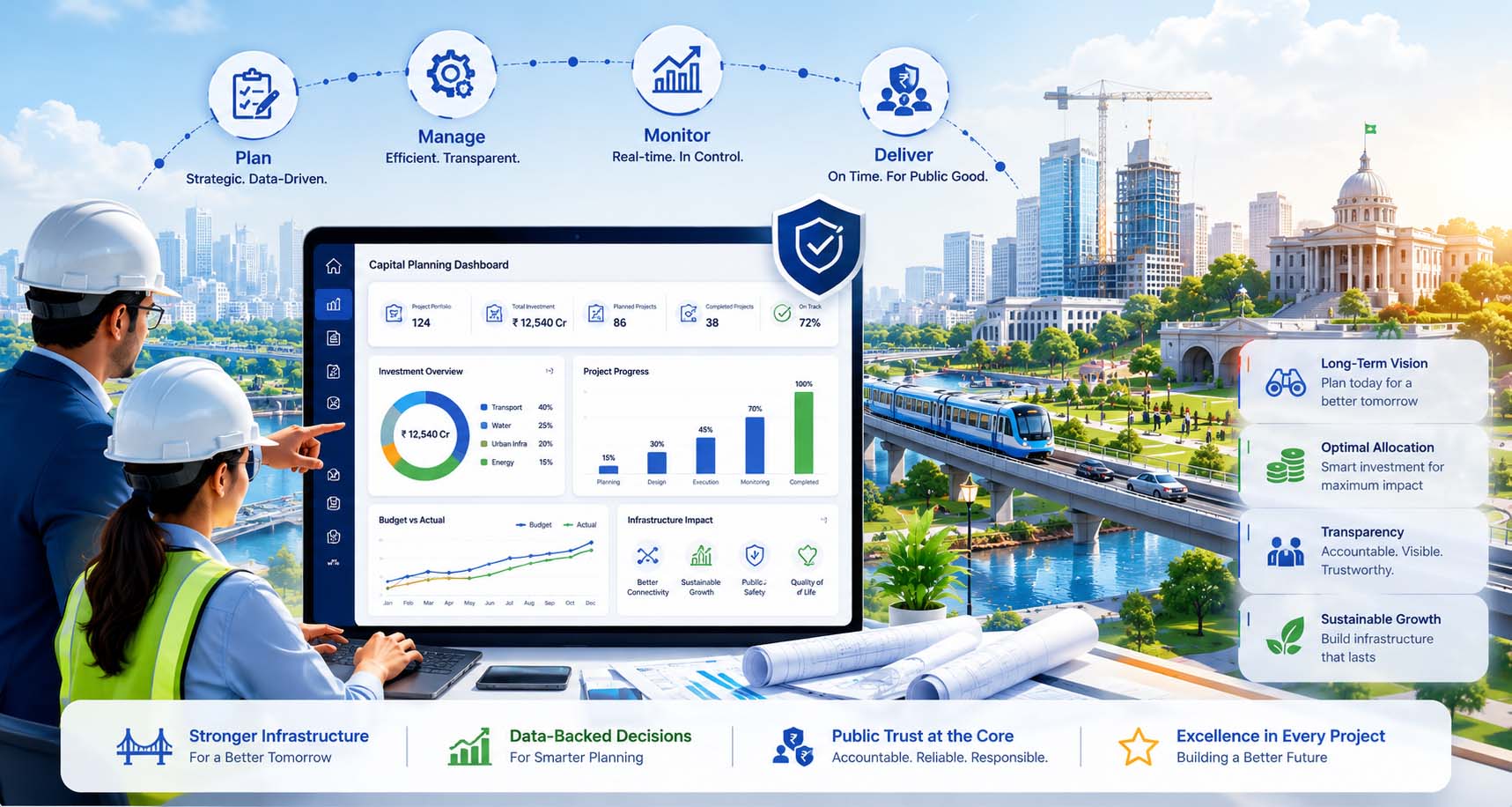
Maximizing the Impact of Every Public Dollar
Government agencies and public sector organizations face a monumental challenge: managing multi-billion dollar, multi-year infrastructure portfolios across shifting political cycles, strict regulatory compliances, and rigid taxpayer budgets.
Our comprehensive platform bridges the gap between long-term vision and field execution. By unifying long-range strategic planning, capital budgeting, procurement, and resource allocation into a single audited environment, we help public leaders maximize the impact of every public dollar.
Core Capabilities for Modern Public Works & Governance
1. Long-Term Capital Improvement Planning (CIP)
- Strategic Objective Mapping: Link every infrastructure proposal directly to your agency’s multi-decade strategic goals—whether it’s green energy transitions, smart-city expansion, or preventative asset maintenance.
- Multi-Year Fiscal & Cash Flow Modeling: Plan 5, 10, or 20 years into the future. Build defensible capital roadmaps that adjust for inflation, track multi-source fund routing (grants, bonds, tax revenues), and predict future debt obligations.
- "What-If" Scenario Analysis: Instantly simulate the impact of macro shifts. What happens to county cash flow if a major highway project is delayed by 18 months? View data-driven risk-versus-reward metrics instantly.
2. Rigorous Financial Control & Public Procurement
- Data-Driven Project Scoring: Erase politics from infrastructure. Use consistent, weighted criteria to automatically score, rank, and recommend public works requests based on community impact, safety, and ROI.
- Budgets, Grants, & Multi-Tier Approvals: Lock in baseline budgets and automate multi-agency approval workflows. Seamlessly manage complex public tenders, evaluate vendor bids, and ensure ironclad contract compliance.
- Inventory & Multi-Site Resource Management: Track regional materials, public machinery, and labor bandwidth to avoid overlapping demands across multiple public site layouts.
3. Uncompromising Risk & Information Governance
- Audit-Ready Document & Decision Management: Centralize engineering blueprints, Environmental Impact Assessments (EIAs), and change orders. Maintain a permanent, unalterable digital ledger of every major administrative decision, meeting minute, and statutory sign-off.
- Cross-Agency Automation Workflows: Eliminate operational silos. Route requests safely between ministries, departments, and external contractors with automated tracking.
The Public Sector Advantage
Total Transparency
Turn complex multi-year infrastructure data into public-facing dashboards. Demonstrate flawless fiscal stewardship to oversight committees, auditors, and citizens alike.
Mitigated Cost Overruns
Stop scope creep and budget leaks early with continuous actual-vs-planned financial reporting across the entire project lifecycle.
Built for Public Security
Role-based access controls, complete digital logging, and data privacy protocols engineered to meet strict public data compliance standards.
The Modern Administrator’s Guide to Capital Improvement Planning (CIP)
A Blueprint for Strategic Multi-Year Infrastructure and Fiscal Excellence
Public infrastructure represents more than just concrete and steel—it is the foundation of city/country image & branding, public trust and economic resilience. However, government agencies face the monumental challenge of aligning long-term master plans with annual fiscal realities, changing regulatory mandates, operational management of the scale, and strict transparency requirements.
This guide outlines the core pillars of an effective Capital Improvement Plan (CIP) which eventually lead to Strategy plan, task planning, long term capital distribution & execution control, plan and demonstrates how modern public administrators transition from reactive maintenance to strategic, data-driven stewardship.
The 4 Pillars of Government Capital Planning
Pillar 1: Establish Long-Term Strategic Alignment
The Challenge: Projects are frequently proposed in departmental silos, leading to a disconnected list of competing needs.
The Best Practice: Establish a clear hierarchical framework where every single 5-, 10-, or 20-year infrastructure proposal must explicitly connect to top-tier administrative objectives—such as climate resilience, civic safety, or equitable zoning.
Pillar 2: Implement Data-Driven Project Scoring
When funding is limited and municipal requests are infinite, public leaders must eliminate subjective bias from project approvals. The Best Practice: Utilize a mathematically weighted matrix to score project requests transparently.
| Evaluation Criteria | Target Impact Area | Standard Weight |
|---|---|---|
| Public Safety & Health | Immediate risk mitigation & emergency reduction | 25% |
| Regulatory Compliance | Meeting statutory mandates or legal decrees | 20% |
| Asset Lifecycle Urgency | Critical failure probability based on actual condition metrics | 20% |
| Fiscal ROI & Cost Benefit | Operational expenditure (OPEX) savings & grant match availability | 15% |
| Strategic & Community Equity | Alignment with long-range master plans & geographic equity | 20% |
Pillar 3: Multi-Source Fiscal & Cash Flow Modelling
The Best Practice: Build robust "What-If" scenarios into your capital modelling. Finance directors must be able to stress-test their 10-year plans against macroeconomic shocks. If a federal grant drops by 15%, or material inflation spikes by 8%, how will it alter local debt service capacity over the next decade?
Pillar 4: Total Cost of Ownership (TCO) Lifecycle Oversight
The Challenge: Capital expenditures (CAPEX) are often approved without evaluating the downstream operational impacts (OPEX), leading to massive deferred maintenance backlogs years later.
The Best Practice: Ensure your procurement, work scope management (WBS), and asset tracking are unified in one system. Every approved capital blueprint must automatically map out a long-term preventive maintenance and inventory schedule.
The Transition: From Spreadsheets to Digital Capital Platforms
Historically, government entities relied on complex networks of static, siloed spreadsheets to track capital pipelines. This manual approach leaves public entities vulnerable to scope creep, unapproved budget variations, and data loss during political transitions. By modernizing your infrastructure pipeline with an integrated Capital Management System, public organizations can ensure an unalterable audit trail of every executive decision, automate multi-agency approval workflows, and securely protect public funds.
Streamline Your Civic Infrastructure Journey
Are you ready to transform your agency's long-term capital planning? Contact our public sector specialists today to see how our unified WBS, budgeting, and decision-management platform brings total predictability to your next infrastructure lifecycle.
Empower Tomorrow's Infrastructure, Today.
Transition away from error-prone spreadsheets and fragmented software silos. Equip your administration with an integrated platform that brings data-driven confidence back to capital planning and public project execution.
ProjAuto's Presence

Singapore (HQ)
#01-868V, 1010 Dover Road Singapore, 139658
Email: info@projauto.io
Phone: +65 8751 0591

Malaysia
Penthouse, Mid Valley City Kuala Lumpur, 59200
Email: info@projauto.io
Phone: +65 8751 0591

Dehradun, India
House no 74/35, Near Composite Engineers Arya Nagar, Rajpur Road, Dehradun-248001 Uttarakhand
Email: info@projauto.io
Phone: +91 8218131833

New Delhi, India
7 Square House, 3rd Floor, Krishna Nagar Opp. B4/148B, Safdarjung Enclave, New Delhi – 110029
Email: info@projauto.io
Phone: +91 8218131833